“Kain Na” - A Love Letter to the Foods that Raised Me
“Kain na” or “Come, let’s eat!” is a phrase often spoken in Filipino households. In my home, it was a call that echoed through each room, carrying with it the weight of comfort and warmth. It is a phrase that raised my siblings and me, signifying more than just mealtimes; it is a symbol of shared experiences around the table between friends, family, and visitors that effortlessly transcend generational gaps and language barriers. Waiting for everyone to be seated before beginning our meal, passing the pot of freshly made rice around the table, and running back and forth from the stovetop to refill our serving bowl with ulam is an unspoken understanding of love that does not require words.
As a second-generation Filipina-American born and raised in the United States, I struggled to navigate parts of my identity. Being oceans apart from my relatives in the Philippines, alongside my inability to speak my elders’ native tongue, I grew up feeling disconnected from my roots. Yet, the foods that filled my home seemed to remedy these feelings of detachment; each gathering at the table evoked a sense of comfort and belonging – knowing that within each spoonful of rice and ulam, I was consuming the values and the love that had been passed down from generation to generation.
So I write this piece – not as a simple appreciation for Filipino food – but as an ode to the flavors and the aromas that danced throughout my home; to the countless moments spent in the kitchen; and most importantly, to the people who raised me into who I am today.
With that, kain na!
Arroz Caldo & Fried Tilapia
Since I was about four years old, I always looked forward to Friday nights. Not because the weekend was approaching, but because Friday evenings were reserved for piano lessons at my cousin’s house.
Between my cousin, my brother, and me, we frequently argued over who would be the first to begin lessons with my teacher, Ms. Joanna. As the youngest among them, I consistently lost that battle and would spend the next hour practicing pieces by Debussy and Beethoven.
At the start of my lesson, Ms. Joanna would demonstrate the piece I was to practice. I would stand behind her, observing her fingers effortlessly glide across the ivory keys, hitting each note with precision and grace. Despite my attempts to concentrate on her playing, the noises in the kitchen – cabinets slamming shut, vegetables being cut on the chopping board, pots and pans clanking – pulled my attention away from the classical music.
Now it was my turn to replicate what I had just heard. Settling into my chair and resting my hands on the keys, I began to play each note accordingly. As I read through the sheet music, however, the volume in the kitchen increased; the lids of the pots rattled with fury, and the tilapia sizzled and crackled on my tito’s cast-iron pan.
“The food will probably be ready soon,” I thought to myself as I flipped to the fourth page of Beethoven’s Moonlight Sonata.
As I neared the end of my piece, the living room filled with the smell of Arroz Caldo and fried Tilapia. The contrast between Beethoven’s melancholy notes and the abundance of laughter traveling from the kitchen into the living room painted a messy yet cohesive picture of the two differing worlds.
“Kain na, tayo!” my tito would yell.
Following each lesson, everyone would gather around the table, including Ms. Joanna, who relaxed her posture, trading the rigidity of the piano bench for a seat at our crowded table. As my tito fixed me up a bowl of freshly-made Arroz Caldo, topped with a halved boiled egg, alongside a plate of rice and fried fish, he would describe to us his life in the Philippines before moving to the States.
For hours on end, the adults would share with us naïve kids moments from their childhood, followed by a list of tips and tricks on navigating life; Ms. Joanna would chime in, offering us a glimpse of her life in Poland and her path towards becoming a pianist.
So these were my Friday nights. Evenings stitched together by food and laughter, where conversations crossed borders, flowing seamlessly until our bowls were empty.
Beef Kaldereta
It was my last dinner with my family before moving away for college in Michigan, and I had one last request for my mother: to make Kaldereta as my parting gift.
Beef Kaldereta is a rich, tomato-based stew thickened with liver spread, featuring simmered vegetables such as potatoes, carrots, and bell peppers. The slow-cooked beef, paired with the savory and tangy tomato sauce, is a combination like no other that soothes all ailments.
Knowing that this was my favorite dish, my mother frequently made Kaldereta throughout my childhood. It is a dish that fulfilled me on the gloomiest of days; a dish that completes a celebration; a dish that reminds me of my mother.
My mother grew up in what is known as the “Heart of the Philippines,” Marinduque. She often spoke about home, recounting early mornings on the farm, moments spent waiting for my Lolo to come home from work, and food-filled gatherings with all the neighborhood titos and titas.
Home, for her, is inseparable from the dishes she makes today, and cooking Kaldereta was her way of bringing back a piece of Marinduque into our home. Whenever it simmered on the stove, the kitchen filled with a familiarity beyond my years, beyond the life she had built in the U.S. So when she made Kaldereta for my last dinner before I left for college, I understood it as her unspoken words of love and intention, as her final farewell to me. With a full pot on the stove, she ladled the stew into my bowl, making sure I had more than enough.
That evening, my family and I sat around the table until our bowls were wiped clean, bellies full, and spirits high.
Lumpia
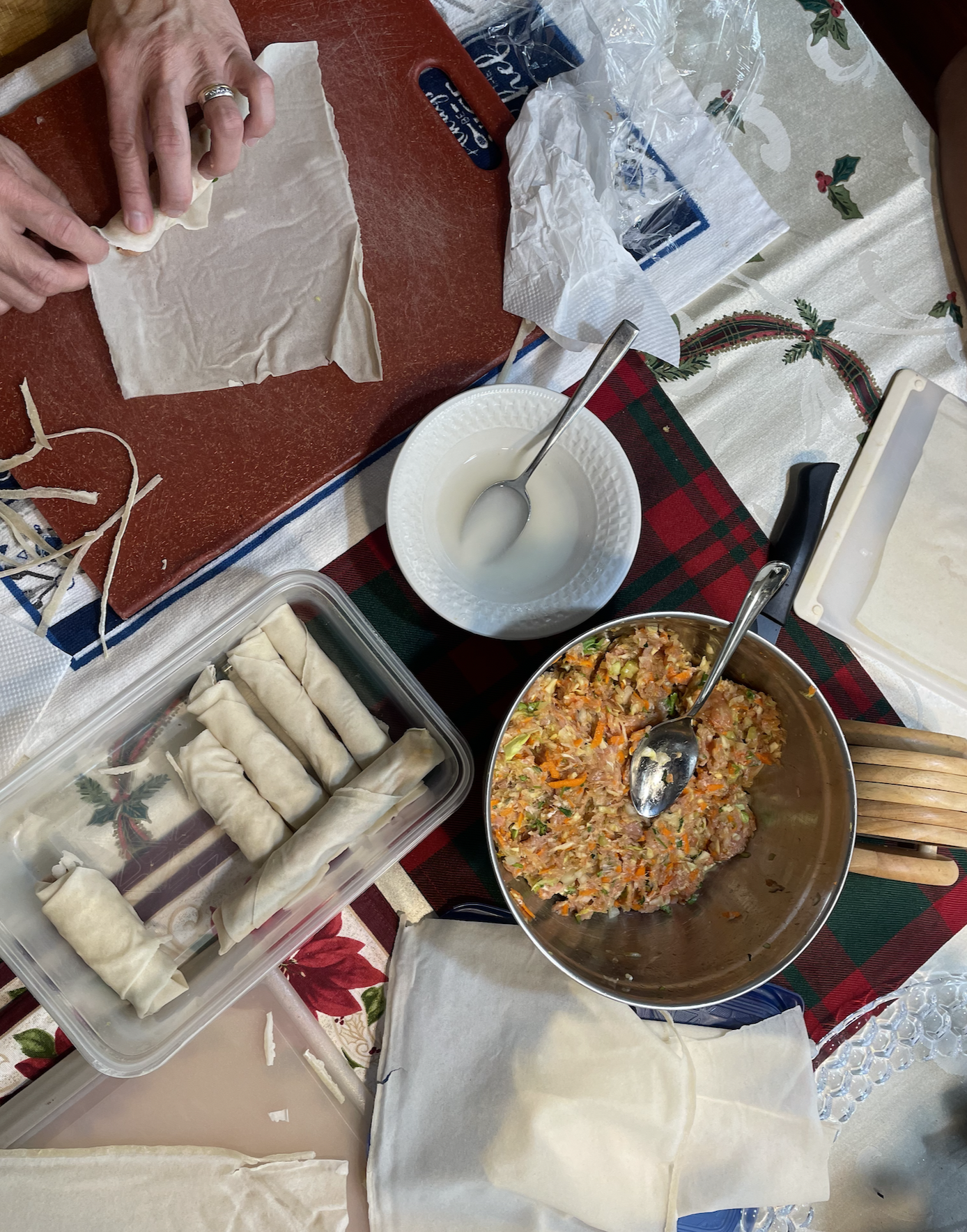
This past Christmas Eve, my brother and I were tasked with rolling lumpia, a popular Filipino spring roll characterized by its crispy, golden shell and soft, delectable stuffing. With the lumpia wrappers sprawled on one side of the table, the steamed pork and vegetable filling overflowing in two large bowls, and ramekins filled with eggwash, our dining table had been transformed into a vibrant, messy mosaic of colors waiting to be assembled.
I observed my father as he meticulously rolled each and every piece of lumpia. Stuff, fold, roll, repeat. Suddenly, I was nine years old, standing on my toes with my eyes barely above the kitchen counter, observing my Lolo diligently roll his lumpia, just as my father was doing right in front of me. My Lolo handled each ingredient with care, following the same steady rhythm. Stuff, fold, roll, repeat.
In an instant, a rush of pride and nostalgia overwhelmed me. Despite the passage of time, the oceans apart, and the changing kitchens, nothing about that steady motion had changed. The same movements lived on in my father’s hands, just as they once lived in my Lolo’s. In that moment, I realized that while so much of the world around us had shifted, this had remained constant.
Lumpia is more than a dish. It offers a glimpse into the past, while nourishing the hands and the mouths of the present. My Lolo’s hands once fed my father. My father’s hands have cared for my siblings and me my entire life.
Now, as I move into the next few chapters of my life, I carry with me the depth of love and care that my Lolo and father have instilled in me, from one piece of lumpia to the next.
Closing Remarks
To the foods that raised me, to the kitchens that hummed with life, and to the tables that made space for everyone who entered our home – this is my love letter to you. Each call of “kain na” is a testament to the unconditional love displayed through food and the power of gathering.
So I end this piece with appreciation and gratitude. I carry these foods with me as lessons in community and storytelling, and as a reminder that feelings of home are cultivated through the small moments around us.